

The listed grounds, the evidence each one requires, and the cost of getting it wrong.
The grounds, as the rules set them out
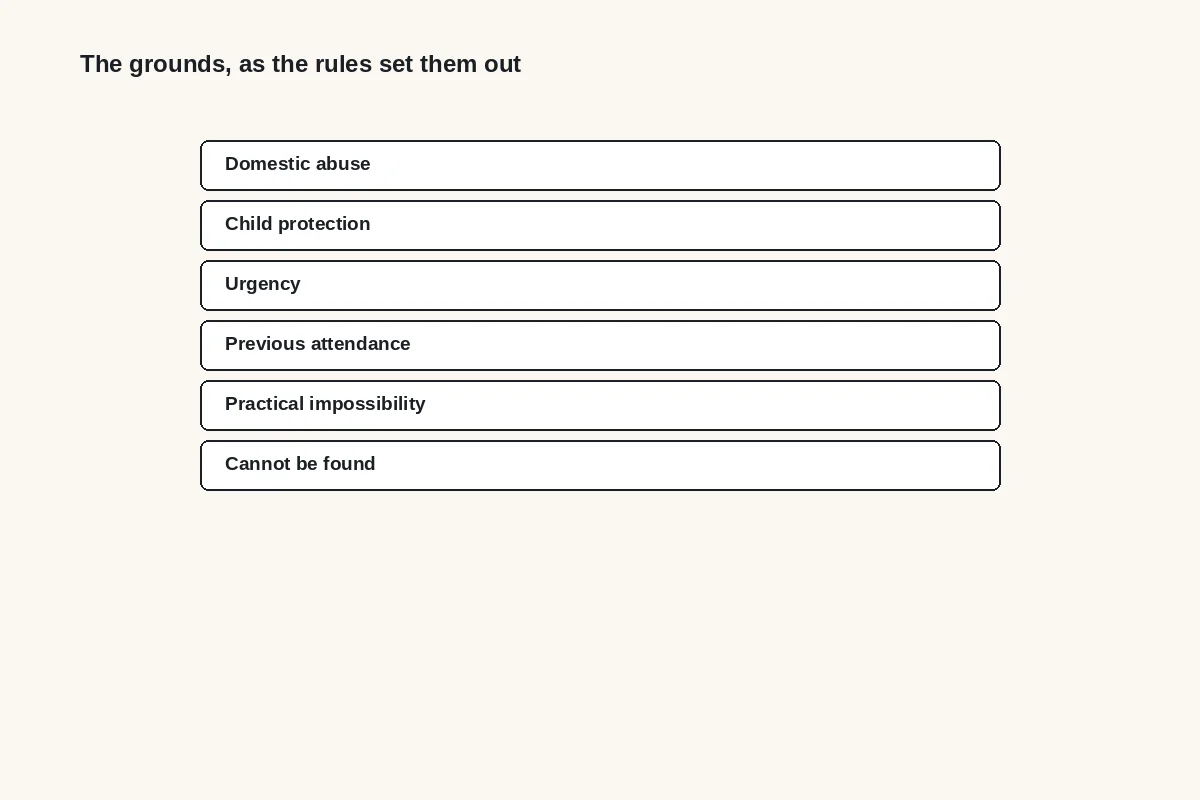
The exemptions are listed in the Family Procedure Rules 2010 and they are specific rather than general. Evidenced domestic abuse between the parties. A risk to the life, liberty or physical safety of a party or their family. A genuine risk of harm to a child. Urgency, meaning a real risk of irreversible problems rather than a preference for speed. Bankruptcy of either party. Prior attendance at a MIAM on the same issue within the previous four months. And a small number of practical grounds, such as no authorised mediator being available within fifteen miles.
Domestic abuse, and the evidence actually required
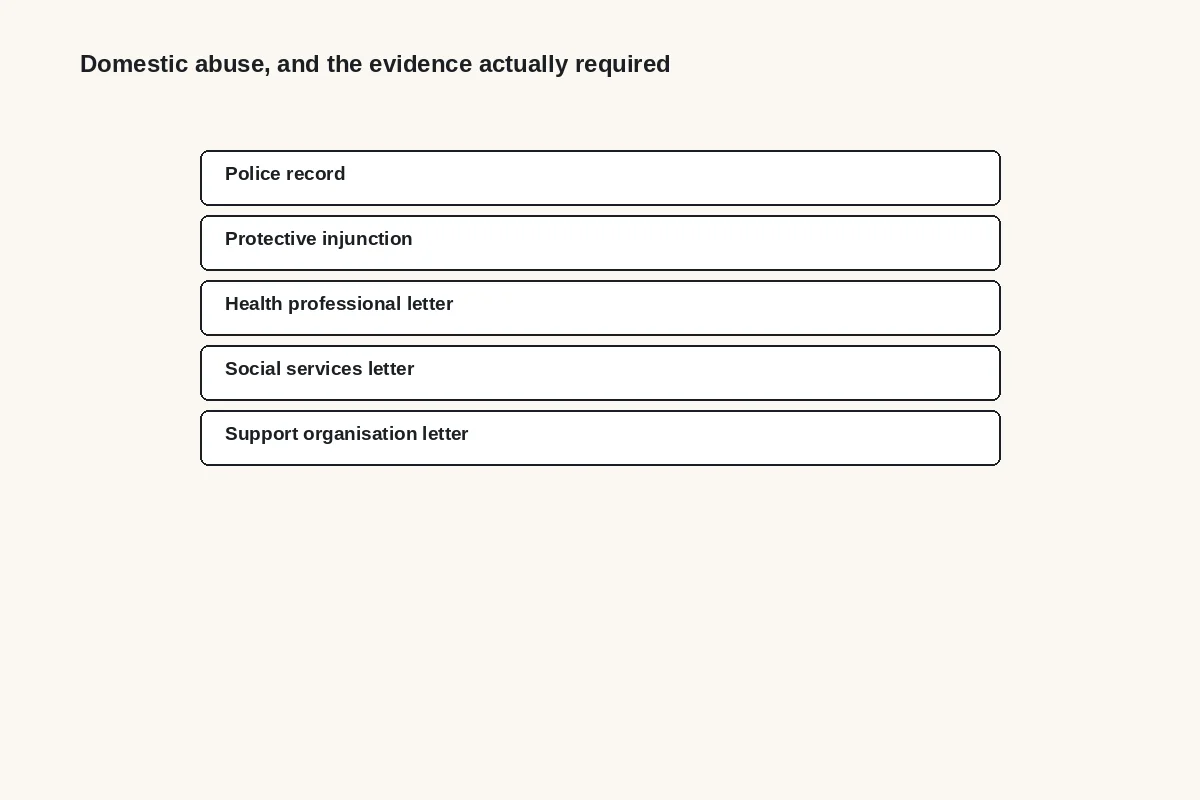
This is the most commonly claimed ground and it carries the most specific evidential requirements. The accepted forms include a protective order such as a non-molestation or occupation order, a police caution or charge for a domestic abuse offence, a relevant conviction, evidence of a MARAC referral, a letter from a health professional confirming injuries or a condition consistent with abuse, a letter from a refuge or domestic abuse support service, or evidence of relevant local authority involvement.
A statement of your own experience is not sufficient on its own for the exemption, and that is a hard thing to read if what you experienced was real. It is better to know it before you file than to have the application returned. If you are in this position, a domestic abuse support service can often help evidence the exemption, and that is worth doing before the application rather than after.
Urgency, and what it actually means
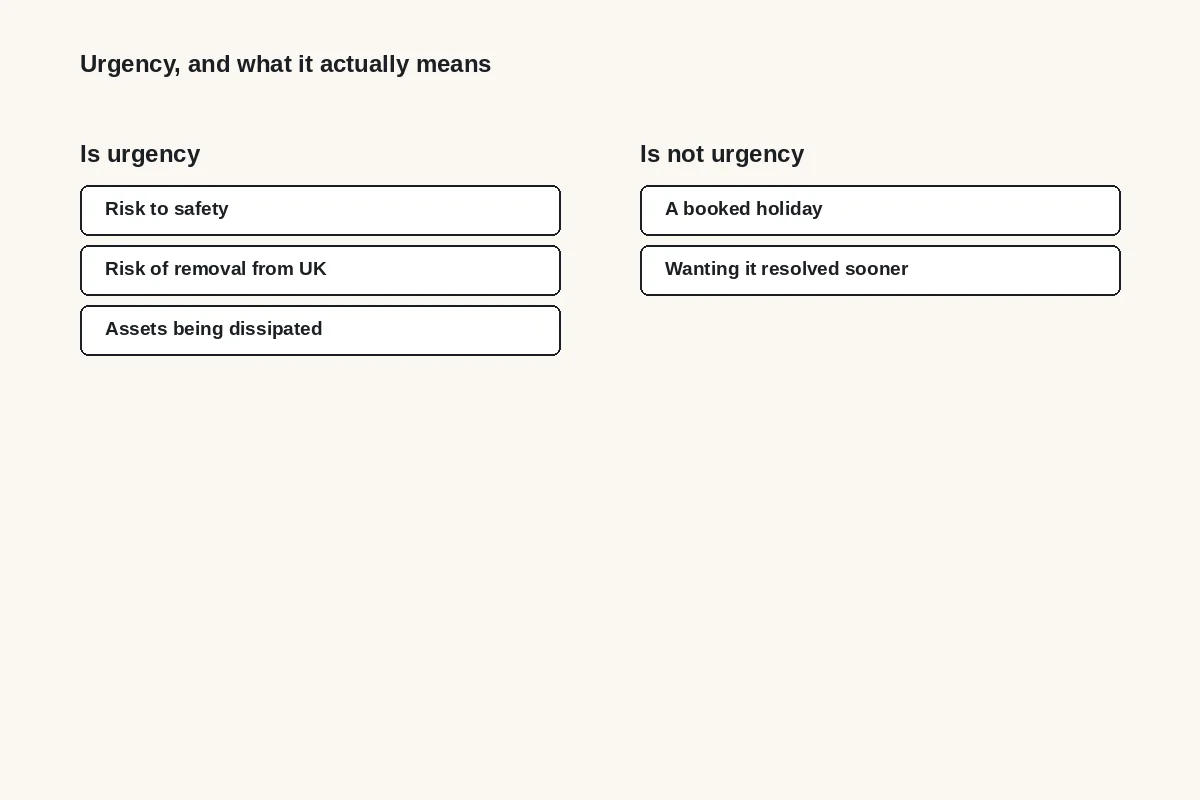
Urgency is narrower than most people assume. It means a risk that delay would cause irreversible harm: a child about to be removed from the jurisdiction, assets about to be dissipated, a genuine safety risk. Wanting the matter resolved quickly, or finding the wait distressing, does not meet it, however reasonable those feelings are.
Prior attendance

If you attended a MIAM about the same issue within the last four months, you do not need another. The four months runs from the date of the meeting. Beyond that window a fresh MIAM is normally required, and the rationale is that circumstances change.
Why claiming one wrongly is expensive

The court reviews the claimed exemption. Where it is not satisfied, the application is returned and you attend the MIAM you were trying to avoid, several weeks later than if you had simply booked one. Court staff and judges see a large volume of these and are experienced at identifying a claim made to save a fee.
Where an exemption clearly applies, claim it. Where it is arguable, attending is usually faster and it costs a fraction of the delay a rejection produces.
What a good mediation service does at this point
Tells you before taking a fee. If you describe a situation where an exemption plainly applies, you should be told that at the enquiry rather than booked. Charging someone for a meeting they were entitled to skip is not a service, and a service that does it is one to be careful.
If you are unsure
Attending is rarely wasted even where an exemption might apply. You will understand the process, you will know whether mediation is suitable, and you will have the form signed. What you should not do is claim an exemption you cannot evidence in the hope it passes, because the cost of that landing badly is measured in months.
Where the exemptions come from
The requirement to attend a MIAM is in section 10 of the Children and Families Act 2014. The exemptions themselves are in Part 3 of the Family Procedure Rules and the practice direction that accompanies it. That matters because the list is closed. A reason that feels compelling but does not appear in the rules is not an exemption, and the court will treat the application as one that should have had a MIAM.
Domestic abuse
This is the most frequently used exemption and the one with the most detailed evidence requirements. The rules accept a range of evidence, including a police caution or conviction, ongoing criminal proceedings, a protective injunction, a letter from a health professional confirming injuries or a condition consistent with abuse, a letter from social services, evidence of a refuge placement, and evidence from a domestic violence support organisation.
The evidence requirements were relaxed significantly in recent years and the time limits that used to apply were removed. If you were told at some point that your evidence was too old to count, that advice may no longer be current.
If you are experiencing abuse, this is not primarily a form-filling question. Contact the National Domestic Abuse Helpline on 0808 2000 247, which is free and open at any hour, or call 999 if you are in immediate danger.
Child protection
Where a child who would be the subject of the application is the subject of a child protection plan, an enquiry under section 47 of the Children Act 1989, or is otherwise the subject of local authority concern, the MIAM requirement does not apply. This exemption exists because those situations are being managed by a statutory process that mediation cannot substitute.
Urgency
The urgency exemption is narrower than people assume. It covers a real risk to life, liberty or physical safety, a real risk of harm to a child, a real risk that a child will be unlawfully removed from the United Kingdom, and a real risk that assets will be dissipated or that a delay would cause irretrievable prejudice.
Inconvenience is not urgency. A holiday booked for next month is not urgency. Courts do scrutinise this one, and an application that claims urgency and is then conducted at a leisurely pace tends to attract comment.
A previous MIAM, or a previous attempt
If you attended a MIAM within the four months before making the application, you do not need another. If you took part in another form of non-court dispute resolution about the same issue within that period, that also counts.
The four months runs to the date the application is made, not the date you decide to make it. It is a common reason for an application to be returned.
Practical impossibility
Several exemptions cover circumstances where attending is not realistically possible. They include being a prisoner, being subject to immigration control that prevents attendance, having no fixed address, being a party to existing proceedings where the court has already been engaged, and having a disability with no mediator in the area able to provide the necessary facilities.
There is also a distance exemption: where no authorised family mediator has an office within fifteen miles of your home. Since remote mediation became routine, this one is used far less than it once was, and a mediator who offers video sessions is generally treated as accessible.
Where the other person cannot be found or will not engage
If you do not know where the other party lives and cannot reasonably find out, that is an exemption. So is a situation where the other party is unable to attend for a reason such as serious illness.
Note the important distinction: the other person simply refusing to attend is not an exemption. In that situation you still attend a MIAM yourself, and the mediator signs the form to record that the other party declined. This is the single most common misunderstanding about the rules, and getting it wrong costs an application fee and several weeks.
How the court checks
The court will look at the exemption claimed and, since the rules were tightened, is expected to check it rather than accept it at face value. If the exemption is not made out, the court can direct that a MIAM take place before the application proceeds, which returns you to where you would have been while having spent the fee and the time.
Judges have made pointed observations in reported cases about exemptions claimed on thin grounds. The practical advice is straightforward: if your exemption is genuine, claim it and evidence it properly. If it is arguable, attending a MIAM is faster than arguing.
The applications the requirement does not cover
Not every family application needs a MIAM in the first place. Consent orders are outside it, because there is nothing in dispute. So are applications for an injunction under Part 4 of the Family Law Act 1996, applications concerning female genital mutilation and forced marriage protection, and applications made within existing proceedings.
Emergency applications made without notice are also outside it for obvious reasons.
The practical question underneath all of this
Most people asking about exemptions are asking one of two different questions. Some are asking because attending would genuinely be unsafe, and for them the exemption exists and should be used without hesitation.
Others are asking because they believe the other person will never agree to anything and the meeting will be a waste of time. That second group is worth pausing on. A MIAM is one meeting, attended alone, with no obligation attached to it, and mediators regularly find that a person described as impossible turns out to be frightened rather than obstructive. It is not always true. It is true often enough that a single meeting is usually a better bet than several months of proceedings.
Filling in the form correctly
On the C100 the exemptions are set out with a box for each. On the Form A the equivalent section is shorter. In both cases you tick the specific exemption relied on, and the evidence is filed with the application rather than produced later.
Two mistakes account for most returned applications. The first is ticking an exemption without filing the evidence, on the assumption it will be requested. It will not be, the application will simply be queried. The second is ticking more than one exemption in the hope that one will hold, which invites scrutiny of all of them.
Claim the exemption that is actually made out, file the evidence with it, and nothing further is usually needed.
If you are not sure whether yours applies
A mediator will tell you. That conversation is part of what a MIAM covers, and it is also available at the point of enquiry with most services, at no cost.
It is a short call and it resolves the question definitively, which is a better use of twenty minutes than an application returned six weeks later with the fee spent and the position unchanged.
How Mediation Direct can help in Hastings
The meeting the court expects you to attend before applying, explained without jargon.
Frequently Asked Questions About Our Services in Hastings
Is my own statement enough to evidence domestic abuse?
Not on its own. The rules list the accepted forms, which include protective orders, police involvement, convictions, and letters from health professionals, refuges or support services.
What counts as urgent?
A real risk of irreversible harm, such as a child about to be removed from the country or assets being dissipated. Wanting a faster answer does not meet the test.
What happens if the court rejects my exemption?
The application is returned to you and you attend a MIAM anyway, weeks later. Where an exemption is arguable rather than clear, attending first is usually faster.
Does the four month window run from the MIAM or the application?
From the date you attended the MIAM. Beyond four months a fresh one is normally required.
Can I get help evidencing a domestic abuse exemption?
Yes. Domestic abuse support services and refuges can often provide the letter the rules accept, and doing that before you file avoids a returned application.
Is there an exemption if my ex-partner refuses to attend?
You do not need one. You attend your own MIAM, the mediator signs the form confirming mediation is not proceeding, and your application continues.
Does bankruptcy really exempt me?
Yes, where either party is bankrupt the exemption applies, because the bankruptcy process changes what can be agreed about the assets.
What if there is no mediator near me?
An exemption applies where no authorised mediator has an appointment available within fifteen miles of your home within fifteen business days.
Do exemptions apply to financial applications too?
Yes. The same list applies to both child arrangements and financial applications, though some grounds arise more often in one than the other.
Should I claim an exemption to save money?
No. A rejected claim costs weeks of delay, which is far more expensive than the meeting. If money is the concern, ask about legal aid and the voucher scheme instead.
About the author

Authored and reviewed by Family Mediation Council (FMC) accredited family mediators. Every procedural timeline and statutory requirement is verified against the Family Procedure Rules 2010 Part 3 and current Ministry of Justice standards.
- FMC Accredited
- Standards Board Registered
- Authorised MIAM Provider
- MoJ Voucher Scheme
Talk to someone who knows Hastings
No obligation, and nothing is decided on the call. We will talk through where you are and what your options actually are.